

Big goals are exciting at first. You decide you want to write a book, improve your health, grow your business, learn a new skill, or finally get more organized. The problem is not usually ambition. The problem is translation. A goal can feel clear in your head but still remain too big, too vague, or too far away to influence what you actually do on Tuesday morning.
That is where many good intentions quietly break down. People set a strong goal, feel motivated for a few days, and then drift back into reactive work because the next step was never clearly defined. If you want real progress, the goal has to become something concrete enough to guide your week.
Learning how to turn goals into weekly action changes everything. It gives your priorities a place in your calendar, helps you decide what matters now, and makes it easier to keep moving even when motivation is inconsistent. Instead of asking whether you are making progress in a general sense, you start asking a much better question: what does progress look like this week?
This guide will show you how to move from a meaningful goal to a practical weekly plan you can actually follow. You do not need a perfect system, a color-coded life, or unlimited free time. You need a process that is simple enough to repeat and realistic enough to survive a busy week.
Why big goals often stay stuck
Most goals fail for ordinary reasons, not dramatic ones. The goal sounds good, but it never becomes specific enough to act on. A person says they want to get healthier, be more productive, or grow professionally, but they do not know what that means in daily life. Without a bridge between the long-term outcome and the current week, the goal stays abstract.
Another common issue is that people confuse interest with commitment. A goal may matter to you, but if it does not show up in your schedule, task list, or weekly decisions, it remains a wish. A goal becomes real when it starts shaping your time.
There is also the problem of overload. Some people try to improve everything at once. They set five major goals, make ten promises to themselves, and then wonder why none of them get enough attention. Goals need space. If every week is crowded with urgency, distraction, and competing priorities, meaningful progress gets pushed aside by whatever feels immediate.
A stronger approach is to identify one meaningful direction, define what success looks like, and then reduce it to the small number of actions that would genuinely move it forward this week.
Start with a goal that is clear enough to guide action
The first step is to define your goal in a way that gives you direction. A weak goal sounds like this:
- Get in shape
- Be more productive
- Improve my finances
- Grow my audience
A stronger goal sounds more like this:
- Walk 8,000 steps a day and strength train twice a week for the next 12 weeks
- Finish one high-value work project by the end of the month
- Save an additional $300 this month by reducing impulse spending
- Publish four helpful articles this month for my website
The point is not to force perfect wording. The point is to make the outcome specific enough that it can influence your choices. If your goal is still too broad, it is hard to know what deserves attention now.
It also helps to think in outcomes instead of just effort. If you have not read it yet, our guide on outcome-based goals planning is a useful companion because it explains how to plan around results rather than just counting hours.
Before moving on, ask yourself these questions:
- What exactly am I trying to achieve?
- Why does this matter right now?
- What would meaningful progress look like in the next 30 to 90 days?
Once you can answer those clearly, you are ready to turn the goal into weekly action.

Break the goal into weekly outcomes
This is the step that makes the biggest difference. Instead of staring at the entire goal, ask what needs to happen in the next seven days.
A weekly outcome is a concrete result you want by the end of the week. It is not just a vague intention such as “work on project” or “do better.” It is a meaningful checkpoint that helps you measure progress.
What good weekly outcomes look like
If your goal is to publish four articles this month, your weekly outcome might be:
- Finish the outline and first draft of one article
If your goal is to improve your health, your weekly outcomes might be:
- Complete two gym sessions
- Prep three lunches for workdays
- Walk at least 8,000 steps on five days
If your goal is to improve focus at work, your weekly outcomes might be:
- Schedule three 90-minute deep work blocks
- Finish the project proposal draft
- Reduce afternoon email checks to two scheduled windows
Choose fewer outcomes than you think
Many people weaken their own system by planning too much. A weekly plan is not a place to write every possible good idea. It is a place to define what matters most. In most cases, one to three weekly outcomes for a major goal is enough.
This keeps your attention focused and makes progress easier to see. It also helps you separate true priorities from optional extras. If everything is important, nothing is being aimed at clearly.
Turn outcomes into next actions
Once you have the weekly outcomes, break each one into next actions. These are the tasks you can actually do. For example:
- Weekly outcome: Finish the first draft of one article
- Next actions: research topic, create outline, write introduction, draft main sections, revise closing
That is the bridge between the goal and your week. Goals create direction. Weekly outcomes create focus. Next actions create momentum.
Put the actions into your actual week
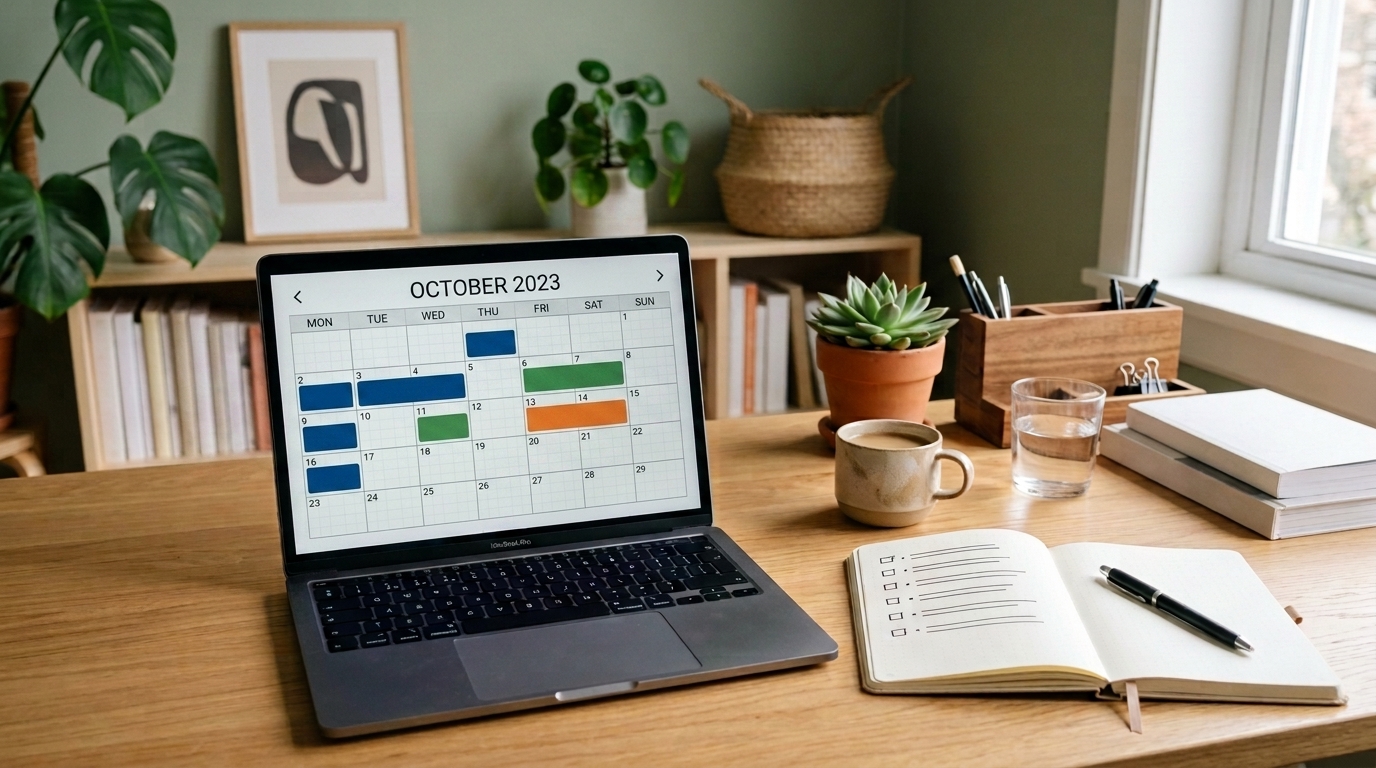
A weekly plan becomes much stronger when it moves beyond a list and enters your real schedule. If you leave important actions floating in a task app with no time attached, they will compete with meetings, errands, email, interruptions, and general life friction. Important work needs a home.
Protect time for the work
Look at your week and assign time blocks for the actions that matter most. If writing is important, block writing time. If exercise is a goal, block exercise time. If strategic planning matters, make space for it before your week fills itself with reactive work.
This does not mean every hour must be controlled. It means your priorities should show up in a visible and intentional way. A goal that never reaches your calendar often gets treated like a suggestion.
If protecting time is difficult, our guide on the real cost of context switching and deep work can help you understand why focused time matters so much and how easily it gets lost.
Use tools carefully
Digital tools can help, but they should support the process, not complicate it. A simple calendar, task manager, and notes system are usually enough. If you rely on AI or digital tools, use them to clarify your week, organize tasks, or summarize ideas, not to create more complexity. Our article on AI productivity tools that actually help offers a practical way to think about this.
Create a minimum version of the week
One of the smartest things you can do is define the minimum version of success. Busy weeks happen. Energy changes. Unexpected tasks appear. When that happens, what is the smallest version of your weekly plan that still counts as progress?
For example:
- If you cannot do four workouts, can you still do two?
- If you cannot finish the full report, can you still complete the outline and key data section?
- If you miss a long writing block, can you still draft 500 words?
This approach helps you stay consistent instead of giving up when conditions are imperfect.
Track progress without overcomplicating it
Tracking matters because it closes the loop between intention and reality. When you monitor progress, you can see whether your weekly actions are actually moving the goal forward. You also notice problems sooner. A weekly plan without any review can become a ritual that feels organized but produces little learning.
The good news is that tracking does not need to be elaborate. A short weekly scorecard is enough for most people.
Use a simple weekly check-in
At the end of the week, review three things:
- What outcomes did I complete?
- What did not happen, and why?
- What should I adjust next week?
You can keep this in a notebook, notes app, or spreadsheet. The format matters less than the habit of checking in honestly.
There is strong reason to take this seriously. An American Psychological Association meta-analysis on monitoring goal progress found that progress monitoring is meaningfully associated with goal attainment. In simple terms, people tend to do better when they regularly check whether they are actually moving.
Measure the right things
Do not only track effort. Track meaningful results as well. Time spent can matter, but outcomes matter more. If you planned to complete a draft, submit an application, or walk five days this week, record whether that happened. This keeps the goal connected to real-world movement rather than just activity.
Expect friction and plan for recovery
No system works perfectly every week. That does not mean the system is broken. It means you are a person with a real life. Travel, stress, illness, heavy workloads, family obligations, and low-energy days will interfere from time to time. The key is not to avoid all friction. The key is to recover quickly.
Do not turn one bad week into a broken identity
Many people miss a week and immediately start thinking, “I am inconsistent,” “I never stick with anything,” or “There is no point trying again.” That reaction causes more damage than the missed week itself.
A better response is to review the week with curiosity. Was the plan too ambitious? Did the actions lack time blocks? Were your tasks unclear? Did your environment make success harder? Did you try to build too many habits at once?
If consistency has been difficult, read why productivity habits fail for a deeper look at the common reasons routines fall apart and how to make them more sustainable.
Reset with the next week, not next month
You do not need a dramatic restart. You need a clean next week. Reconnect with the goal, define one to three weekly outcomes, and begin again. Fast recovery beats perfect performance.

A simple example of turning a goal into weekly action
Let us say your goal is: “Improve my professional writing and publish consistently for the next three months.”
That goal is still broad, so you turn it into a 30-day target:
- Publish four high-quality blog posts this month
Now you define this week’s outcomes:
- Choose one article topic
- Create the outline
- Draft 1,200 to 1,500 words
- Edit and prepare the post for publication
Next, you assign the work:
- Monday: research and outline for 45 minutes
- Tuesday: write first half of draft
- Thursday: write second half of draft
- Friday: edit, add links, and prepare images
At the end of the week, you review the result. If the draft is complete but not fully edited, that still teaches you something useful about your pace. You now know what to plan more accurately next week.
This is what turning goals into weekly action looks like. It is not glamorous. It is clear, repeatable, and grounded in what your life can actually support.
Create a weekly planning rhythm you can repeat
The best goal system is not the most detailed one. It is the one you can repeat week after week. Try setting aside 20 to 30 minutes at the start or end of each week to review your goal, choose your outcomes, identify the next actions, and protect time for them in your schedule.
If you are still building your overall system, the Start Here page is a good next step because it will help you connect goals, focus, habits, and tools into a more consistent approach.
Over time, this weekly rhythm does more than keep you organized. It changes your relationship with progress. You stop hoping your goals will somehow fit into life, and you start giving them structure. That is what makes momentum possible.
The bottom line
If you want a goal to influence your life, it has to become actionable at the weekly level. That means getting specific about the outcome, choosing a few realistic weekly targets, turning them into next actions, and assigning them a place in your week. Then you review what happened and adjust without drama.
Goals are not achieved in one giant moment. They are built through ordinary weeks that are planned with enough clarity to keep moving. When you learn how to turn goals into weekly action, progress becomes easier to see, easier to repeat, and much harder to lose.